
Boudhanath Stupa build around 6th century AD, also called Boudha, is one of the most important Buddhist sites in Nepal and a UNESCO World Heritage Site since 1979. It stands in the northeastern part of Kathmandu, attracting thousands of Buddhist pilgrims and tourists every day.
The first stupa was built after AD 600, during the time of King Songtsen Gampo of Tibet, who converted to Buddhism. According to legend, the king built the stupa to repent for accidentally killing his father. The original stupa was destroyed by Mughal invaders in the 14th century, and the current structure was rebuilt later.
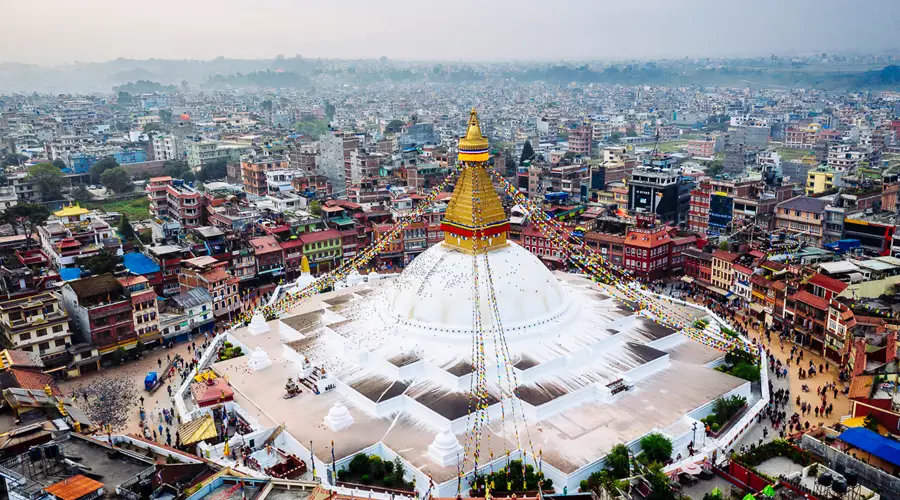
The white dome, gold tower, and all-seeing eyes of the Buddha make the stupa one of the most beautiful monuments in Nepal. Every morning and evening, Tibetan monks and pilgrims walk around the stupa in a clockwise direction — called kora — spinning prayer wheels and chanting mantras. After Tibetan refugees arrived in the 1950s, many monasteries were built around Stupa, making it the spiritual heart of Tibetan Buddhism in Nepal.
The design of Boudhanath Stupa is full of Buddhist symbolism:
- The plinth (base) represents earth
- The dome (kumbha) represents water
- The square tower (harmika) represents fire
- The spire represents air
- The umbrella on top represents space or heaven
The 13 steps of the spire symbolize the 13 stages to reach nirvana (enlightenment).
Many believe the stupa holds holy relics — some say the relics of the Buddha Kashyapa, while others say it contains a bone of Siddhartha Gautama, the historical Buddha.
Around the base are 108 small Buddha images of Amitabha and 147 prayer wheels, which visitors spin for good luck and blessings.
Visitors can climb the plinth (base) from the north gate near a small shrine of Goddess Hariti (Ajima), protector from smallpox. From 5 AM to 6 PM (till 7 PM in summer), the platform gives a beautiful view of the stupa and the people doing their koras.
The Boudhanath Stupa is not just a monument — it is a living center of peace, faith, and Tibetan culture in Nepal.